
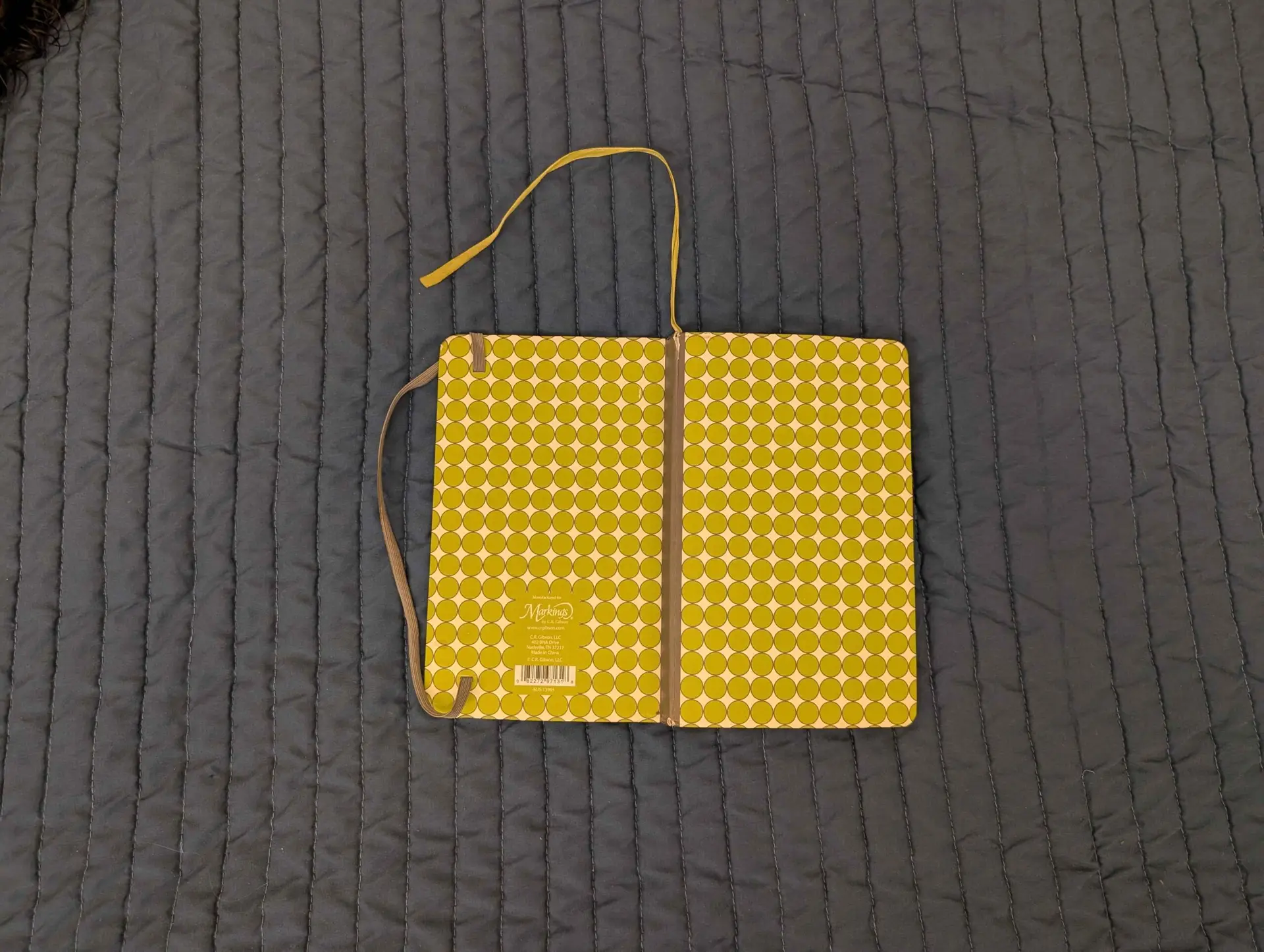
By this point you may have read about my 10-year notebook, a notebook that’s really stood the test of time and one that I just keep going back to.
Does it have special paper, thick and absorbent, filled with dots and grids, lined with inspiring quotes, and formatted specifically for highly stylized journaling techniques? No, no, no, no, and no. It’s a durable notebook that has peripheral qualities that go way beyond the paper.
Here are key things to look for in a notebook that matter more than the pages.
The Spine
Notebooks essentially have three styles of spine. They’re very important but I don’t think they get enough forethought from buyers. Here’s to making the spine the number one thing you think about, not the last.
The first is a ring system. Done well this can allow you to have the pages flat, if that’s a requirement for you. But, the rings need to be strong or the long-term viability of the notebook will be greatly lowered. And that’s especially the case if you intend to stuff your notebook in your purse or backpack. It’s also easy to get pages semi-ripped out of these. Tread carefully here unless it’s really a necessity to get that crease out and have a flat page.
Next we have the flat-backed binding that creates a book-like edge. This is my favorite, and what my 10-year notebook uses. The binding is solid and the pages are staying intact even after years of usage. It also just feels nice to stack with other books in my collection.
Finally, we have the rounded spine from what I’ll call “composition notebook binding” which nearly always has these. It’s that one where long pages are stitched through at the middle and folded over. There’s typically always a reinforced area along the spine here, too, which may or may not work. I like these better than ringed spines but far less so than flat-backed ones. These are good on cheap, disposable notebooks, such as for a semester course, but aren’t necessarily the things you want to have aged notes in. Or, so I’ve discovered.
The Cover Material
Covers come in a wide variety of styles, from scratchy surfaces to flimsy cardboard. But there are just a few types that I find to be ideal.
For composition books, some have a cardboard exterior while others have a thin plastic exterior. I’ve found that the thin plastic exterior feels really cheap but performs well when it comes to preserving your notebook’s integrity.
Regular-sized diaries and journals come with tons of exteriors. Some might like leather, a known durable material, but it’s not my thing. Instead, a sort of hard cover, like a regular book, is my preference.
Finally, there’s the mini notebooks, or pocket-sized notebooks that some people carry. A thick cover defeats the point on these, in my opinion, though I’ve seen book-like covers done well. Instead, for these, aim for the denim-like covers that even affordable brands like Tru Red are able to put out.
Its Size
I know there are pocket notebooks, ones that hold A4 paper, and everything in between and beyond. This is not about that.
This is about the precise size of the notebook.
Let me explain. As my 10-year notebook slowly fills up, I know it may be time to get the second one in the series. And, I’ll admit, I want one that has the same dimensions so they’ll line up well together in a stack or on a shelf some day.
I have no idea, after all, how much I’ll use my big important main notebook in the next few years. I might go through two or three of them in one year or the next one may last an extra decade longer than the first. Going forward, this is something I won’t forget to look at.
A Bookmark Ribbon Bound Inside
You know those little ribbons you see coming out of the ends of some notebooks, and even some Bibles? They’re extremely useful for notebooks that you intend to have for the long haul. There are some pages in my 10-year notebook that I’ve used for tracking things that I know I’ll need to come back to several times over the course of months, so I just leave the bookmark (that will never fall out, by the way) there.
The ribbon is totally overkill on a semester’s composition book, but a non-negotiable for something you intend on using throughout life.
And a Clasp to Close It
If your notebook has a clasp, not only does it look nicer, but the pages will also last longer. The one on my 10-year notebook is an elastic band that is built into the backside of the booklet and wraps around to the front. While this has worn out slightly, it is still functional. For a decade, that’s pretty great. So, while you might want a stronger clasp mechanism for your long-term notebook or journal, don’t count out the power of an elastic band.
Some Thoughts About Pockets
So, that 10-year notebook has a couple of tucked away pockets in the inside of the cover panels. I’ve used them lightly over the years and have some thoughts both good and bad about these stowaway spots.
I think it’s convenient to have pouches to stuff things like pieces of paper, receipts, flyers, etc. into. That goes without saying.
However, if it gets too convenient, you can overstuff these quick. And, if you have a stretched out wallet, you already know that you’re the type that’s susceptible to this sort of squirreling behavior.
If long-term integrity is what you’re going for, paper pocket flaps are also the first thing that are going to rip, too, if used enough and that will give your prized journal an overall worn look.
Pockets are good, but not necessarily essential, IMO, and totally skippable unless you’re going for something in particular.