
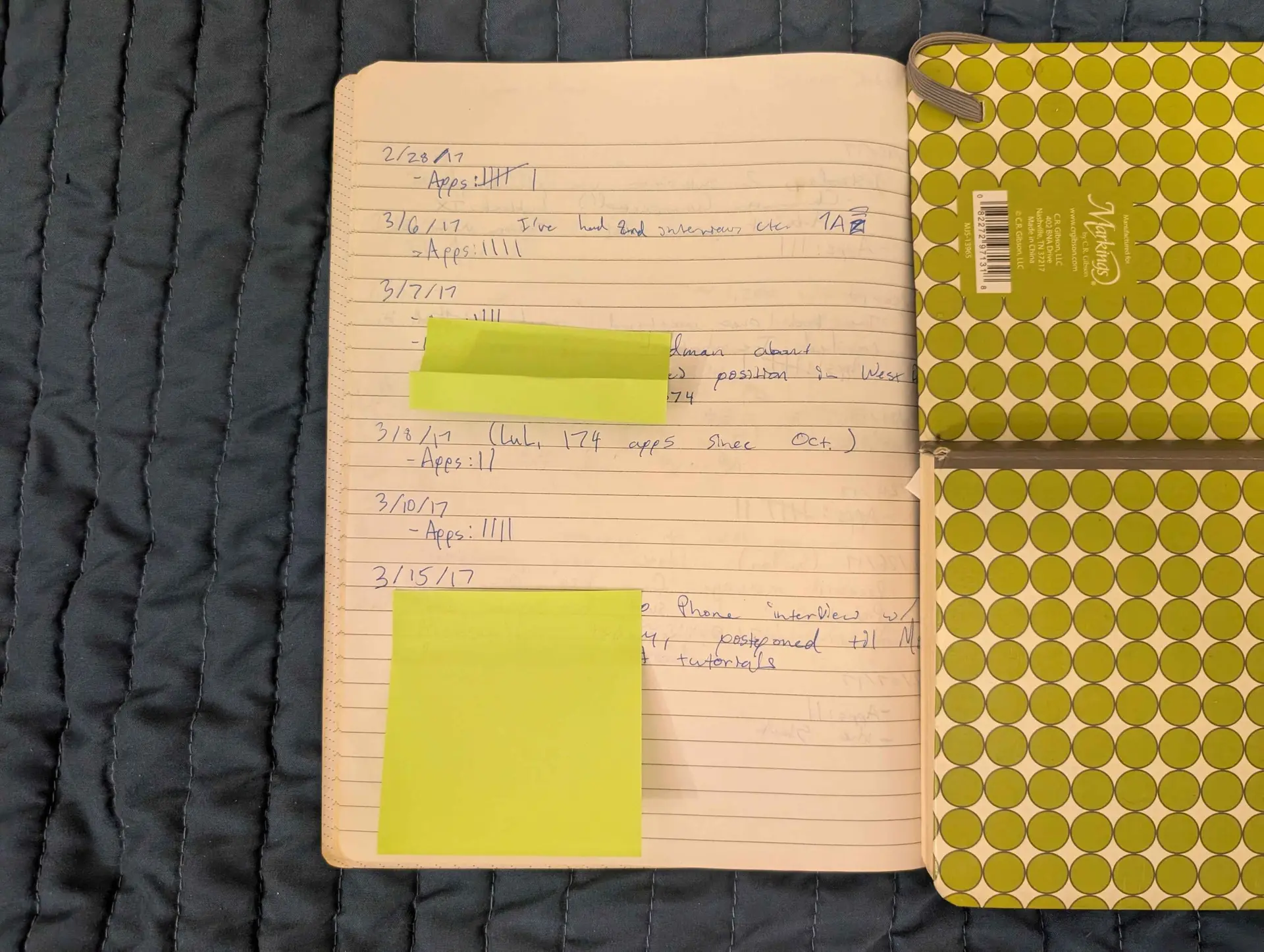
Do you ever look back at your life and wonder why you were such a lazy bum at that point? Does that point in your life include this week, yesterday, or this morning? You’re not alone, but a simple lab journaling method I started using years ago in my STEM career has absolutely straightened out my mind, increased my self-confidence, and helped me reframe years of my life’s progress.
What is a laboratory notebook?
Laboratory notebooks are used, naturally, to document a researcher’s results in the lab. And while you can do that in your at-home lab journal style notebook, too, that’s not what we’re talking about today.
Many researchers are also directed by their supervisors to write down what they did every day.
As a low-level grunt in the lab (aka a lab technician), there’s not always a ton to do that’s “important” from a research standpoint. Sometimes you clean, sweep, or take inventory for tomorrow’s experiment. It’s important, yes, but not exactly research. I decided to write it all down.
At first I felt a little bit silly about this, like I was being too literal with the instructions. Or passive aggressive or something. But it did help document when things were cleaned, when data was uploaded, and more. There are times when those things are useful and practical! And at the end of the day (or week or month), when I looked back, what I saw was a time that was busier and much more productive than I had remembered or felt.
A Lab Notebook Journal at Home
When that lab job ended, however, and I entered a period of prolonged unemployment at home, I no longer had that notebook to help remind me of what I was doing.
So, I got one.
And through it, much like at the USDA, I journaled my productivity. All of it. Each application, no matter how easy or hard to finish, was tallied. Notes on upcoming or current interviews fit in there, too.
How Lab Notebook Journaling Changed My Self-Perception
As I’ve said, these notebooks have helped me feel good about my work before. But when brought into my own home, especially during a period of extended unemployment, a lab notebook actually changed how I feel about an era of my life.
There were days when I did 13 job applications. 13! Sure, some of them were a 2nd application at a company I’d just applied for, a single extra click, but I really did the work. Rejection after rejection, accounts of an ongoing illness that was way scarier at the time (undiagnosed, then) than it is now, a nigh-on-infinite array of job application tally marks, and some house chores sprinkled in for good measure.
I wasn’t a “loser” or “failing” at that time! I was giving it a real go in a phase of life where it isn’t uncommon to face repeated rejection. That notebook documents over 200 applications, moments of extreme fear in the illness, and a few near misses in interviews. And if you’re going through a period of your life where you’re worried about productivity sliding, especially amid intense failures and repeated rejections, then it’s the perfect time to start your own lab-style journal.
Advice on Starting Your Own Lab Notebook Productivity Journal
If you’re wanting to try this yourself, here’s what I suggest:
- Though any composition book will do, a notebook with graph-style paper will give you an authentic lab-style feel, which might help bring about a feeling of non-judging, highly observant introspection.
- Don’t start a notebook like this just because. Wait until life is on the edge and your productivity feels like it’s at rock bottom. It’ll make it more impactful as opposed to something you do all the time.
- Do date every entry.
- Don’t go to a new page for every entry.
- Do make entries short. Sometimes the best sort of entry is “Apps: III” or whatever metric you’re tracking and nothing else.
- Do use bullets.
- If something big is going on, it makes sense to add some notes about it. Do what feels best.
- Track everything! You’re going to be seriously impressed with yourself later, even if it feels small now.