
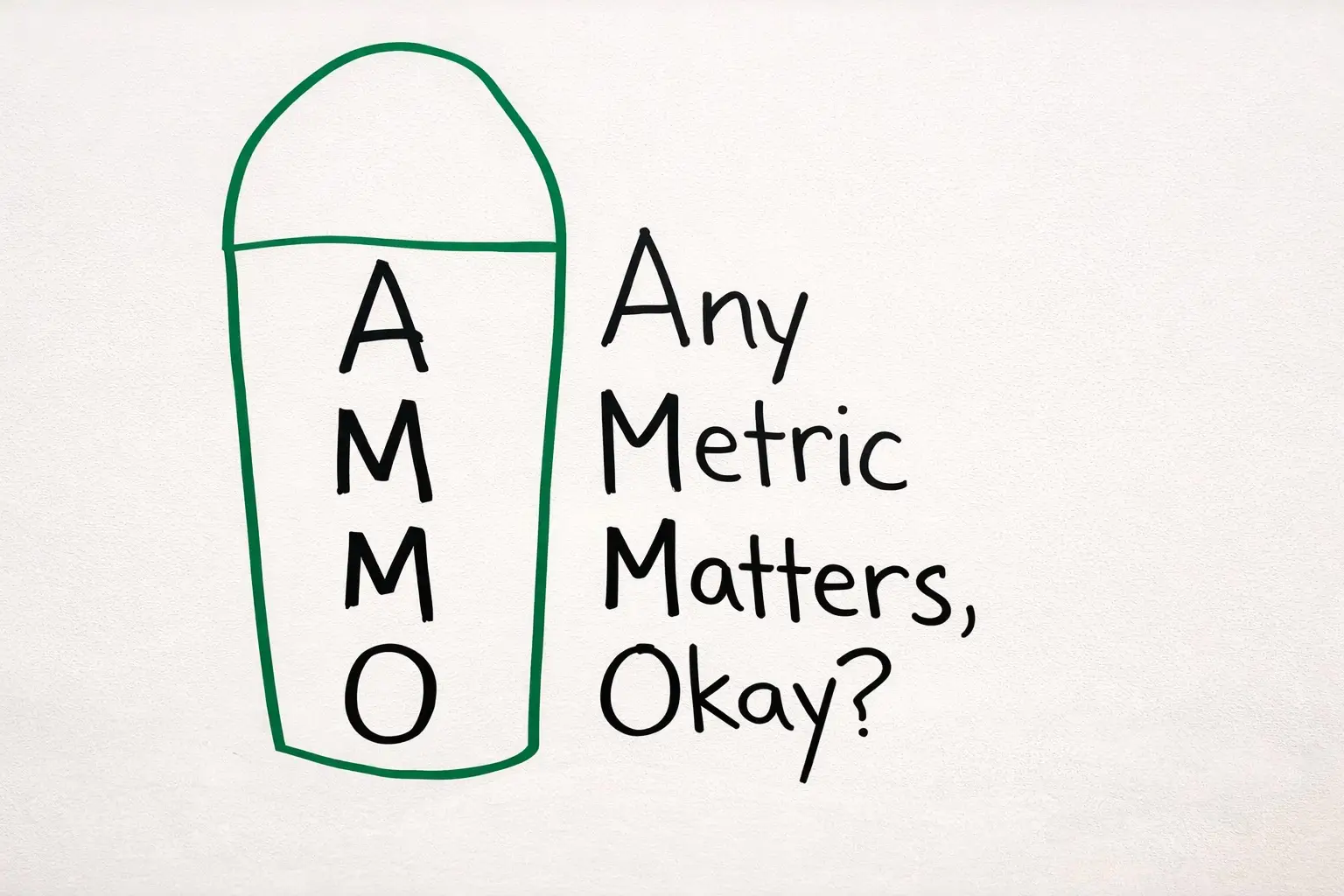
One of the greatest things that happened for my career was writing. Yes, even in the 2020s, writing is still a way to get ahead monetarily and professionally, instead of a way to fall behind. Part of it is about writing really well, but another is just how many metrics start to fall directly into your lap, as A.M.M.O., ready to help you land a more stable or higher paying position in your career.
“Any Metric Matters, Okay?” (A.M.M.O.) is the mantra here. The idea is to get a number and to use it, and that just about any number will work. Writing, though truly a landscape of words, is also filled with numbers on the professional scale. Here, we’re going to go over why numbers matter for your career, where to find them, why I think any career can benefit from some A.M.M.O., and some thoughts on what metrics to avoid.
Why Metrics Matter
Any Metric Matters, Okay?
But why? Writers so often think the perfect word choice is the key to success. It can get to a point where every email feels like a slog because every word shows your skills as a writer. A chance to show style and flourish where others would sound generic.
In reality, it couldn’t be further from the truth. As long as you’re following basic email etiquette and displaying coherent grammar and structure, your words are fine.
What your editors, future bosses, publishers, and clients need to know are the numbers. How much you can write, how much that writing earns, how well that writing ranks. With these numbers, more than any other thing, that person that you want to work with can start to see who you really are.
Metrics Are Everywhere
What kinds of metrics matter?
Any Metric Matters, Okay?
Here are some high-tier metrics (X) you can report that might be important for your next writing job:
- I can write X well-researched words in one hour about a breaking news item.
- I receive X page views or more per month for a site that I write for Y hours per week.
- My turnaround time for a piece of length Y, from assignment to delivery, is typically X.
- My edits increased traffic to target pages by X% last month.
- I published X self-directed articles about Y during critical period Z.
- My writing earned company Y X contracts last month.
The sky is the limit, but you must search.
Ultimately, if you can converge all of this on a metric that shows how much value you brought to a company with your writing and you can convert that to a fair per hour, per piece, or per word rate, then that’s exactly the sort of thing you want to emphasize. That’s what metrics are all about. In writing and freelancing, especially for the web, you’ll find (sometimes for the first time) just how valuable your work really is, how valuable you are in the workplace, at some point if you just keep digging through and finding the right metrics.
The Case of the Hidden Metric
But sometimes you really have to dig deep to find the metric. Is that a problem?
Any Metric Matters, Okay?
If you’re still beginning your freelance writing career you may not have much to go on. Writing about phones? Find a way to mention how many phones you’ve bought over time. Or, conversely, how few phones you’ve bought… because you carefully researched, got excellent cases, and bought for the long haul. The second one might be risky but if you don’t have enough written things to have those sorts of metrics, it is definitely better than nothing. Spin it the right way, own it.
Metrics for the Cashier, Teller, Baker, and Plumber, Too
This is a site about writing, journaling, and notetaking. While most people reading this will likely be writers, I want the rest of you to know that this is good stuff, too.
Whatever you’re doing, try to find the value metric.
If you’re a baker, start counting how many items you bake and multiply that by their sale value. That’s a useful metric. Baking 14 dozen cookies that sell for $8 per cookie is $1,344 worth of cookies baked, an excellent way of thinking about it from a business perspective. The point is, you quantified your efforts in a way that a new manager can understand.
What if you aren’t dealing directly with the product? For example, let’s say you work with clients directly. How many clients are in your regular rotation now? What percentage stay around after three months? Are you so good that they keep coming back, or are you such a problem-solver that the clients’ problems are solved in a short time?
Think and find a metric, and you’ll find you’re next step.
Yes, Any Metric Matters
Now, you may start to think that the metric you found is truly boring and uninteresting. While that might be true from your perspective, it isn’t necessarily so to your employer.
There’s a tendency to think that your metrics aren’t good enough and are, instead, going to turn off the potential client or employer. That’s a normal thought chain, but it’s also quite unlikely if you’re going to be a good fit. Reporting the real you, as you are now, gives the potential partner (it’s best to avoid thinking of your editor as “boss” for now) insight into what you’re like and what you can bring to the table. Concretely.
But, what if the numbers are really, actually… bad?
Bad Metrics (Difficult to Find)
The truly bad metrics are the ones that are hard to find. The secret revenue leak in a document you weren’t supposed to see, a value that’s clearly off-limits to outsiders, or something that reveals more about the organization you worked for than it does you. If you think you might get sued or shunned for sharing it, that’s a metric to avoid. However, if you worry that the number “isn’t good enough” or that “nobody cares” you might just be being too harsh on yourself.
Nobody Is Using Metrics Enough
To cap it all off, here’s a story from back in that mystical time where landing on the Google SERP page still meant something for a web writer.
At that time, I had compiled a list of all of the major keywords I had explicitly been told to target. From there I made a Google Doc that that listed the publication, article category (how to, round up, etc.), and then my ranking with a link to the SERP. I highlighted the top ones in gold, silver, and bronze, and added it as an attachment to applications and cover letters. None of this was secret data or even Semrush data, it was just effort-driven content with good metrics.
When that document did generate an interview I was flabbergasted by what the editor told me. To paraphrase, “I’ve never seen anyone do something like this before.”
In my mind, I’d done the most basic thing you should ever do for a web writer position and I was greeted with a very good compliment. While I never did end up working with that company, I know I was noticed because of this work, and later iterations of it helped land me in a role better suited to me not long after. Go find your metrics and try them out!